Why Does Ask Maps Matter for Local Businesses?
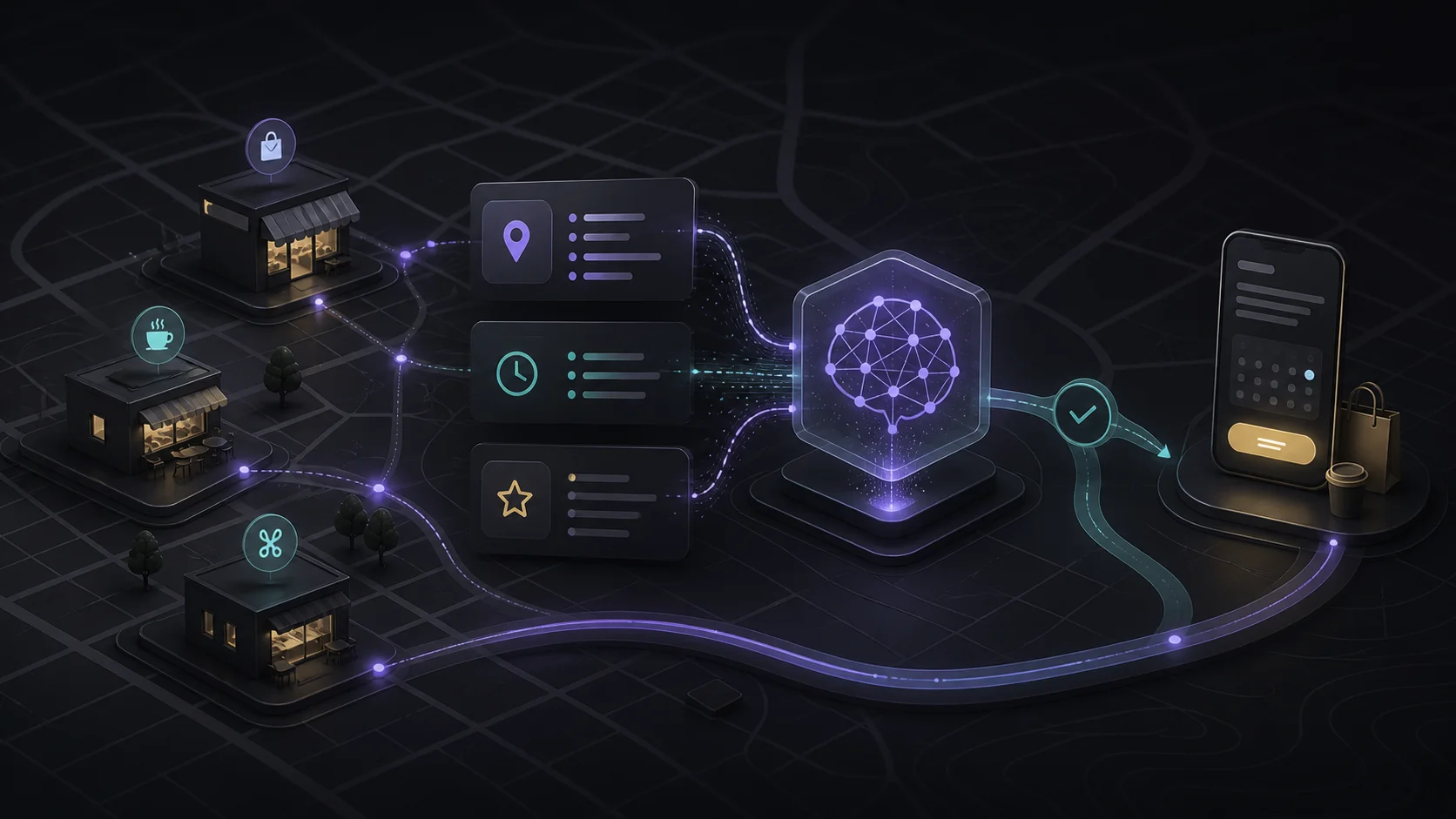
Local search used to end with a list of places. The newer question is whether the map can help a person move from a natural-language request to a useful next step. That changes the practical standard for local visibility: information needs to be accurate, specific and connected to an action.
On 6 August 2026, TechCrunch reported that Google is adding agentic capabilities to Ask Maps: users can find food and add items to a cart through supported platforms, compare hotel prices and availability before visiting a partner site, and find event tickets. The reported expansion is rolling out to users in the United States. Google’s March product announcement describes Ask Maps as a conversational layer for complex local questions, with results that can lead to reservations, saved places or directions.
RxAI Insight
The useful GEO question is not only “Can AI see my business?” It is “Can the customer complete the next step from the information AI sees?” That is a practical operating test, not a Google ranking or conversion guarantee.
What Has Google Added to Ask Maps?
The current expansion is important because it connects local discovery with actions that used to happen in separate apps or websites:
- Food: Ask Maps can surface nearby options, then let a user add items to a cart through supported platforms such as Square, Toast or Uber Eats before payment on that platform.
- Hotels: Ask Maps can compare price and availability, then send the user to a partner website to complete the booking.
- Events: A user can ask for nearby shows or live music and receive options with links to buy tickets.
- Personal context: Personal Intelligence can use permitted Gmail and Google Calendar context for tailored answers, and Google says it is off by default.
Rollout language matters for Australian SMBs. Google’s current Travel Help page says hotel booking in AI Mode is available only in the U.S. and English and requires a U.S. address saved for Google Pay. A product announcement is not a promise that the same action is live for every Australian searcher, account or business category.
Which Business Details Help Customers Take the Next Step?
When an AI system has to choose between plausible local options, the most useful business information is the information that answers a customer’s next question. For most local businesses, start with three connected fields:
- Availability: opening hours, special-date hours, last-order times and appointment availability should agree across the Business Profile, website and booking system.
- Offer: menus, services, price ranges, dietary options, locations and eligibility rules should use plain language a customer would naturally include in a question.
- Action: ordering, booking, enquiry and ticket links should lead directly to a page where the customer can complete the action, not just to a generic home page.
Google’s Business Profile documentation supports third-party providers and custom ordering links, including “Place an order” links for non-U.S. businesses. The practical priority is not to add every possible integration. It is to make the few paths you already offer accurate and easy to complete. RxAI’s AI consulting and automation services can help map those paths before you automate them.
How Should an Australian SMB Audit Its Google Business Profile?
Use a simple three-column audit. Put the customer-facing claim in the first column, the system that owns it in the second, and the last verified date in the third.
- Check hours and service windows: compare standard hours, public-holiday changes, appointment windows and last orders across Google, your website and staff systems.
- Check the offer: open the live menu, service list or room information and confirm that names, prices, availability and location details still match what the team can deliver.
- Check the link: test each booking, ordering or enquiry button on mobile and in a private browser window. Confirm that it reaches the correct partner or checkout flow.
Think of the Business Profile as a service card that an AI system may read, not just a directory listing. It should be maintained like an operational interface.
What Should You Test Before Promising a New AI Journey?
Run one short customer-path test before changing your marketing claims or buying a new tool:
- Start in a private window and search for the business using a natural-language request, not only its exact name.
- Check whether the profile shows the right hours, service, menu or availability for the request.
- Open every action link and confirm that the next page can actually accept a booking, order, enquiry or ticket purchase.
- Compare what Google shows with the official website and the partner platform that completes the action.
- Record the market, device, account state and date, because features can vary by rollout and permissions.
If you operate a restaurant, hotel, clinic, class, event or mobile service, this test is a useful baseline for local SEO and GEO work. If the path breaks, fix the source data or link first. If it works, document the journey and the human handoff before connecting more automation. You can contact RxAI for a practical review of the highest-value customer path.
Where Can You Verify the Current Rollout?
Keep the product announcement and the operating limits together when you brief a team. The current reporting describes the new U.S. Ask Maps actions, while Google’s own pages explain the original conversational experience, Business Profile ordering controls and regional hotel-booking restrictions. Check the live experience in the market and account you actually serve.
Sources
- TechCrunch: Google Maps adds agentic features, including food ordering and hotel bookings — current report on the 6 August expansion.
- Google Maps Blog: Ask Maps and Immersive Navigation — Google’s product description of complex local questions and actions.
- Google Business Profile Help: Manage online ordering options — provider and custom ordering-link controls.
- Google Business Profile Australia: Restaurant solutions — menu, photos, business information and ordering guidance.
- Google Travel Help: Book hotels in AI Mode — current U.S., English and Google Pay limitations.
Frequently Asked Questions
Ask Maps is Google’s conversational Maps experience for complex local questions. It can surface options and help users move from discovery towards actions such as reservations, ordering or ticket links where supported.
Not necessarily. The current report describes the new agentic features rolling out to U.S. users, while Google’s hotel documentation limits AI Mode hotel booking to the U.S. and English with a U.S. Google Pay address. Businesses should test the live journey in their own market.
Start with accurate hours and service availability, clear menu or service details, and working booking, ordering or ticket links. Then test the path as a customer.
No. Accurate data can make a customer journey more reliable, but Google does not promise that a complete profile will produce a ranking, recommendation or conversion.
Want This Applied to Your Business?
RxAI offers a free 30-minute consultation to map how these strategies fit your operations. No obligation, no sales pitch.
Book Free Consultation