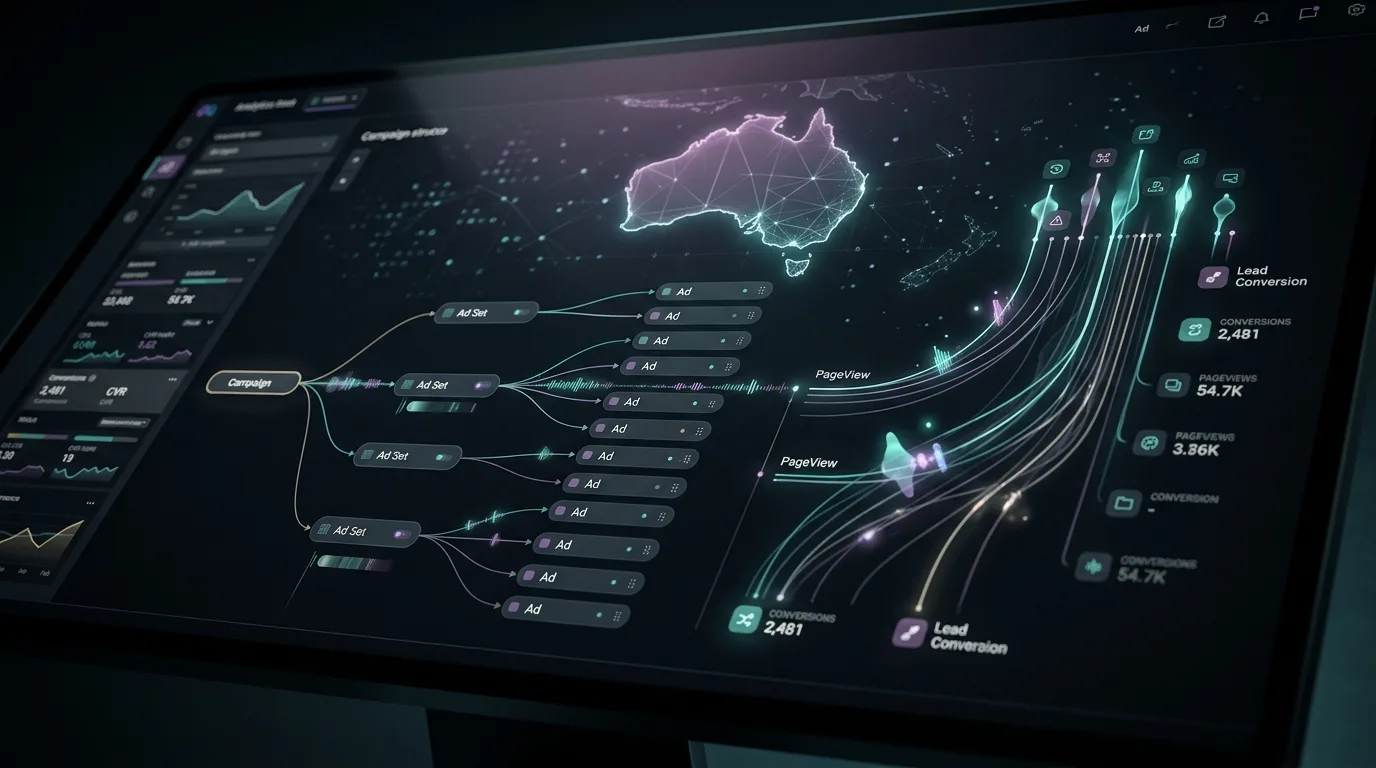
Meta Ads can look deceptively simple from the outside: write copy, pick an audience, set a budget, and launch. In practice, the value comes from the setup work behind the campaign. If the Page, Instagram account, ad account, Pixel, events, and landing page are not connected cleanly, the campaign may spend money without producing reliable conversion data.
This post documents how RxAI approached a full Meta Ads tracking setup from a blank starting point. The source account had no dedicated business Page, no campaign structure, and no live tracking. The goal was to create a credible B2B campaign foundation that could drive qualified traffic to a landing page and measure lead intent.
What Was Built From Zero?
The project began with a brand-new Meta Business environment. Instead of treating the campaign as an isolated ad, we built the operating layer around it: business assets, permissions, tracking, test events, and a launch checklist.
- A dedicated Facebook Business Page for B2B consulting was created.
- The Facebook Page, Instagram account, and ad account were linked in Meta Business Manager.
- A campaign, ad set, and ad structure was prepared for an Australian audience.
- A Meta Pixel was created, installed, and verified with live PageView activity.
- Lead conversion events were added to landing page calls to action.
- The final campaign was left paused until payment method and activation steps were complete.
Why Did Strategy Come Before Campaign Setup?
Before touching ads, the first step was business discovery. The account had multiple social surfaces serving different audiences, including personal-brand channels, English-language channels, and Traditional Chinese channels. That mattered because the campaign objective had to match the commercial goal, not simply the available social accounts.
The primary revenue goal was B2B GEO/AEO consulting: helping businesses become more visible when customers ask AI systems such as ChatGPT, Gemini, or Perplexity for recommendations. That immediately ruled out follower growth as the main objective. A follower campaign might improve vanity metrics, but it would not prove whether the offer was generating qualified business interest.
RxAI Insight
In this setup, the practical outcome was not "an ad is ready." It was a measurable acquisition system: business assets connected, landing page tracking verified, six Lead click events mapped, and the campaign paused for controlled launch.
For businesses considering paid traffic, this distinction is important. The question is not whether Meta can send people to a website. It can. The question is whether your site, tracking, and conversion events can tell you which traffic has real buying intent. If you need that operating layer built around your website, RxAI's automation and AI consulting services can help connect strategy, implementation, and measurement.
How Were the Meta Assets Connected?
The setup used Meta Business Manager as the control plane. The dedicated Facebook Page was added first, then connected to the ad account. The Instagram account was then linked and granted ad account access. That final permission matters: without it, ad creation can fail because the ad account has no access to the Instagram identity.
Business Manager
├── Facebook Page
│   └── Connected Instagram account
├── Ad Account
│   └── Linked to the Instagram account
└── Meta Pixel
    └── Installed on the landing page
This is the unglamorous work that prevents launch friction. It also keeps ownership clearer. Page identity, Instagram identity, ad spend, and tracking should sit under the business rather than being scattered across personal accounts.
How Was the Campaign Structured?
The campaign was prepared as a traffic campaign for the Australian market. The ad set used landing page views as the optimisation goal, impressions as the billing event, and a broad Australian audience. The initial age range was 35-60, matching the decision-maker profile for the B2B consulting offer.
- Campaign objective: OUTCOME_TRAFFIC.
- Daily budget: $15 AUD/day.
- Buying type: Auction.
- Bid strategy: Lowest cost without cap.
- Initial placement: Facebook Feed, with Instagram available after the account connection was confirmed.
- CTA: Learn More, pointing to the landing page.
The creative angle focused on a direct business question: when an ideal customer asks an AI system for a recommendation, is the business visible in the answer? That angle connected the ad to the actual consulting offer rather than selling a generic marketing service.
How Did Pixel and Lead Tracking Work?
The Meta Pixel was installed in the landing page head section and configured to fire a PageView event. This gave Meta a basic signal that visitors had reached the page, not merely clicked an ad. The setup also enabled Conversions API through Meta's configuration path, giving the account a server-side backup route for tracking.
Lead events were then added to the landing page calls to action. The hero CTA, pricing-card CTAs, and footer CTA each fired a Lead event on click. That distinction matters because a visitor who clicks a proposal or contact button is materially different from someone who only views the page.
fbq('track', 'PageView');
fbq('track', 'Lead', {
  content_name: 'GEO Proposal',
  content_category: 'hero'
});
After installation, the setup was checked in Meta Events Manager using Test Events. The PageView event was processed successfully from the landing page, confirming that the browser-side Pixel was receiving activity before the campaign went live.
What Should Happen Before Launch?
At the end of the setup session, the campaign was intentionally left paused. That is the right state when the technical layer is ready but commercial launch controls are not complete. The remaining items were payment method, final ad creative, Lead event testing, and activation order.
- Click each tracked CTA during a test session and confirm Lead events appear in Events Manager.
- Add the payment method in Business Manager billing.
- Finalise the ad creative once the payment blocker is removed.
- Activate campaign, ad set, and ad in a controlled sequence.
- Confirm that the campaign remains aligned to the landing page and proposal request pathway.
The setup also called for the same Pixel to be added to key pages beyond the landing page, including the home page, contact page, and blog pages. That gives future retargeting campaigns a cleaner audience base.
How Should the System Be Optimised After Launch?
The initial campaign used traffic because the account needed data. Once the Pixel records enough Lead activity, the next planned step is to move toward a leads objective. The source plan used 50 Lead events as the threshold, with a rough expectation of 2-4 weeks before considering the switch.
- Start with verified traffic: confirm the campaign can drive landing page views and that events are firing.
- Collect Lead event data: track CTA clicks across the landing page and contact pathways.
- Build retargeting audiences: use website visitors and blog readers once the Pixel is installed across key pages.
- Switch objective carefully: move to OUTCOME_LEADS only after enough conversion signal exists for Meta to optimise toward stronger intent.
- Use proof-led creative: test ads that connect AI visibility, GEO/AEO readiness, and business outcomes.
If you are unsure whether your website is ready for paid traffic, start by checking whether AI systems and search crawlers can understand it. Our guide on sitemap and robots.txt visibility is a useful first audit. For a practical implementation plan, book a free RxAI consultation and we can map the tracking, landing page, and automation steps around your offer.
Frequently Asked Questions
A complete setup connects the business Page, Instagram account, ad account, campaign structure, Meta Pixel, PageView tracking, Lead events, and launch checks so clicks can be tied to useful conversion signals.
The source setup used a traffic campaign first because the Pixel needed conversion data. The next step was to switch to OUTCOME_LEADS after roughly 50 Lead events had been collected.
Key calls to action should be tracked so Meta can distinguish casual page visits from stronger buying intent. In this setup, the hero, pricing, and footer CTAs each fired Lead events.
Not usually. For B2B consulting, qualified landing page traffic and proposal requests are more useful than follower growth because they connect ad spend to commercial intent.
Want This Applied to Your Business?
RxAI offers a free 30-minute consultation to map how these strategies fit your operations. No obligation, no sales pitch.
Book Free Consultation