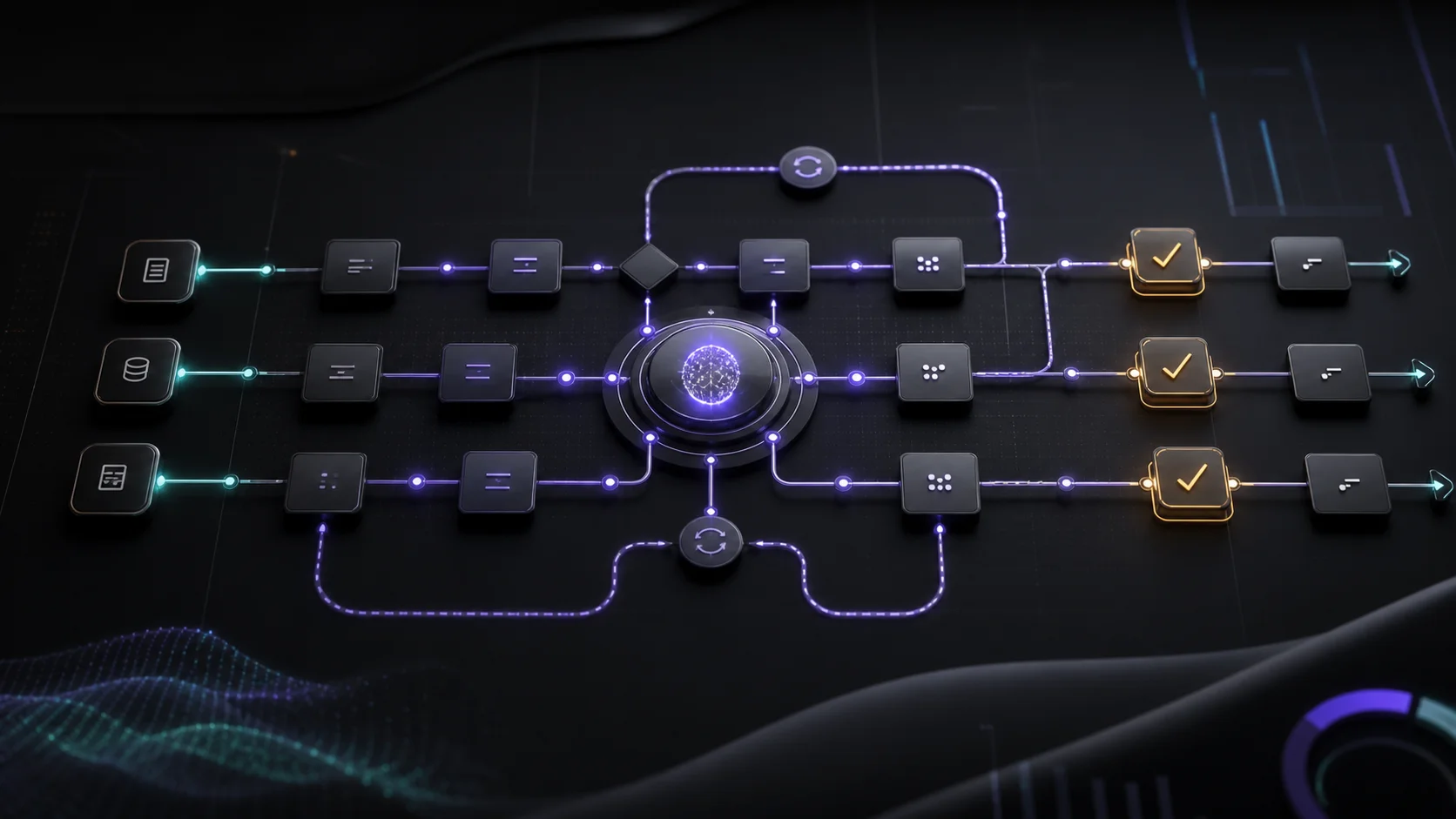
Why can't a bigger prompt replace a workflow?
Many businesses start agent experiments by pasting an SOP into a prompt and asking the model to follow it. That can be useful for a demo, but it is fragile when the workflow touches customers, refunds, records, contracts or publishing.
Google's explanation of ADK 2.0 is direct about the risk: production agents can get stuck in loops, bypass business logic through hallucination, or fail without a clean exception path. Those are operating risks, not copywriting problems. A longer prompt does not give a business durable control over routing, retries, state, approval or exception handling.
The practical lesson for Australian SMBs is simple: if a process must happen in a fixed order, it should be represented as a workflow. The model should help where ambiguity exists, such as classifying a customer request or drafting a response, while deterministic logic should control the steps that must run reliably.
What changed in Google ADK 2.0?
Google describes ADK 2.0 as moving agent development toward a structured workflow runtime and a task-collaboration model. In business terms, that means separating flexible reasoning from predictable execution.
Routing, scheduling and error handling are orchestration problems. They are usually better handled by code and workflow systems than by asking an LLM to remember every rule in every situation. ADK 2.0 points to workflows that can compose deterministic steps, tool calls, human review, LLM calls and specialised agents.
Implementation Note
Before an agent touches a live system, describe the workflow as states and transitions: what starts it, what evidence it needs, where it can branch, what can be retried, and what requires approval.
How does ADK for Go 2.0 make this pattern more concrete?
Google's ADK for Go 2.0 announcement makes the workflow pattern more explicit through a graph-based workflow engine. Developers can describe applications as nodes and edges, then use a scheduler to run the graph.
The source material highlights routing, fan-out and fan-in, loops, state persistence, pause and resume, retries, timeouts and concurrency controls. Those features matter because real agent work is rarely a single chat turn. A support agent may need to classify a request, retrieve order data, draft a response, request approval, log the result and resume later if a person needs to review it.
Where should human review sit in an agent workflow?
Human-in-the-loop review is not a sign that an AI workflow has failed. It is often the control that makes automation deployable. Google's Go 2.0 announcement describes workflow nodes that can pause for human approval, correction or additional information, then resume durably after the response.
For SMBs, the approval points are usually obvious: refunds, contract changes, ad spend, customer complaints, public posts, compliance-sensitive advice and destructive changes in a business system. AI can prepare the work, gather context and recommend the next step, but the business should decide which actions require a person before execution.
What should SMBs map before they automate?
The right starting question is not "Should we use an agent?" It is "Which parts of this process are fixed, which parts need judgement, and which parts need approval?" That framing turns automation from a novelty into an operating model.
- Map the current workflow from trigger to final record or customer response.
- Mark every fixed step that should run the same way each time.
- Mark every judgement step where an LLM can classify, summarise, draft or recommend.
- Add approval gates for high-risk decisions and external-facing actions.
- Define retry, timeout and escalation rules before the workflow goes live.
- Log inputs, decisions, approvals, failures and outcomes so the workflow can be improved.
How should an SMB start safely?
Start with a narrow workflow where the value is visible and the risk is contained. Good first candidates include form triage, support categorisation, quote preparation, content drafting, inbox summaries or internal task routing.
RxAI helps businesses turn these ideas into practical systems: scoped workflows, clear permissions, human review, monitoring and a rollout plan that matches the risk of the process. Explore our AI automation and consulting services, or use the contact page to map a production-ready agent workflow.
Sources
- Google Developers Blog - Why we built ADK 2.0
- Google Developers Blog - Build reliable multi-agent applications with ADK Go 2.0
- ADK official documentation
Frequently Asked Questions
Google ADK 2.0 is Google's updated Agent Development Kit direction for building production agents with structured workflows, task collaboration and more deterministic control over application flow.
Graph-based workflows make the agent process visible and controllable. They help teams define routes, retries, approval points, state and recovery paths before automation touches live business systems.
No. Simple drafting or summarisation tasks may not need one. Workflow design matters when the agent takes multi-step actions, uses tools, handles customer records or affects money, compliance or public communication.
Add approval before external messages, refunds, contract changes, ad spend, publishing, destructive system changes and any decision where the business would normally require manager review.
Want This Applied to Your Business?
RxAI offers a free 30-minute consultation to map how these strategies fit your operations. No obligation, no sales pitch.
Book Free Consultation