
AI-assisted checkout is moving from an abstract product idea into a practical operations question: when a customer approves a purchase, what exactly gives your team permission to fulfil it? For a small Australian online store, the safest answer is not a screenshot of a chat or a green tick in one system. It is a short, auditable match between the buyer’s approval signal, the payment result and the merchant’s confirmed order.
What does ChatGPT Wallet change for a small online store?
On 13 November 2026, OpenAI announced ChatGPT Wallet as an early agentic-commerce payment flow. The announcement says it is initially available through dots to eligible ChatGPT Pro subscribers in the United States. The Help Centre describes a gradual rollout for eligible US Pro users, with a supported device for biometric verification, an eligible US-issued card and a US billing address. That is not an announcement of Australian availability, and Australian businesses should not design their fulfilment process around an assumption that the feature is already available to local shoppers.
The operational detail is still relevant. Before a purchase, the customer reviews the merchant, items, total and selected card, then approves with a security check such as Face ID or Touch ID. A payment network provides a substitute credential rather than exposing the customer’s original card details to the business or agent. OpenAI’s announcement frames the flow as a way to use existing merchant systems, while the commerce payment guide says an existing checkout processes the payment.
That combination creates a useful design prompt for Australian SMBs. You do not need a Wallet-specific integration to start improving your internal control. You need to decide which records your team must match before an order can move into fulfilment, and what happens when one of those records is missing, pending or inconsistent.
Why is buyer approval different from a merchant order?
Buyer approval answers one question: did the customer authorise this particular purchase in the agent-assisted flow? It does not answer whether your checkout accepted the transaction, whether a payment was final, whether your order system created a valid order or whether your fulfilment rules allow release.
OpenAI’s own product material keeps those responsibilities separate. The Wallet announcement says customers transact directly with businesses, which keep control over pricing, fulfilment, returns and customer service. The Commerce Partner Playbook puts “the business confirms the purchase or booking” at the end of the journey. The ChatGPT release notes make the boundary even plainer: approval alone does not confirm an order, so the merchant confirmation must be checked after checkout.
For a small team, this is less about a new product than about avoiding a familiar handover failure. A customer may say “I approved it”, the payment gateway may show a pending or declined result, and the order platform may have no matching record. If customer service treats any one of those signals as the whole truth, it can tell the customer the wrong thing or release stock before the business has a recoverable record.
The right response is calm and specific: “We are checking the payment and order records against the same transaction reference. We will confirm the next step once the records match.” That message protects the customer relationship without inventing a status.
RxAI Insight
A buyer approval signal is an input to reconciliation, not a fulfilment trigger. The safest automation boundary is the point where payment and merchant order records agree and a named person can still review the result.
What does a three-column checkout control look like?
Use three columns because each one answers a different operational question. Keep the worksheet small enough to use in a chat handoff, but precise enough for somebody with the right permissions to verify the original records.
| Column | What it records | What it does not prove |
|---|---|---|
| Buyer approval | Customer or agent report of approval, including the time and source if known. | It does not prove that the bank, gateway or merchant accepted the transaction. |
| Payment result | Authorised operator’s view of status, reference, amount and currency in the payment system. | A pending, declined or mismatched record is not a successful payment. |
| Merchant confirmation | Order ID, order state, payment reference, amount and currency in the store system. | A draft, cancelled or unpaired order is not permission to release stock. |
For a prepaid physical order, a conservative “ready for human review” condition is: the merchant order is confirmed, the payment result is final under your gateway’s documented status, the payment reference matches the order reference, and amount and currency match. That condition is a local operating rule, not a Wallet field or a guarantee from OpenAI. If your business captures later, takes deposits, supports subscriptions or fulfils pre-orders, define the corresponding rule with your payment provider and keep the human review stage.
Do not ask a customer to paste a full card number, security code or one-time verification code into a shared worksheet. The Help Centre says card details and verification codes belong in secure forms, not chat or support messages. Your control should use the minimum internal reference needed to find the original records.
What did our 12-case rehearsal show?
We ran a bounded local rehearsal on 16 November 2026 at 23:04:28 AEDT, using Python 3.14.2 on Darwin and the package’s saved command. The sample contained 12 fictional, one-time prepaid physical-order cases. Each case had a buyer-approval value, a payment status and reference, an amount and currency, plus merchant-order status and matching fields. The expected outcome was written in the input before the decision rules ran.
The baseline asked only whether the buyer had approved. In this deliberately mixed fixture set, 2 of 12 cases were correctly ready for human review, 8 of 12 were marked ready too soon, 1 was correctly held and 1 case that could be reviewed was held because the approval signal was unknown. The reconciliation rule required a confirmed order, a final successful payment and matching reference, amount and currency. It produced 3 correctly ready-for-review cases and 9 correctly held cases, with no premature ready decisions. All 12 expected labels matched.
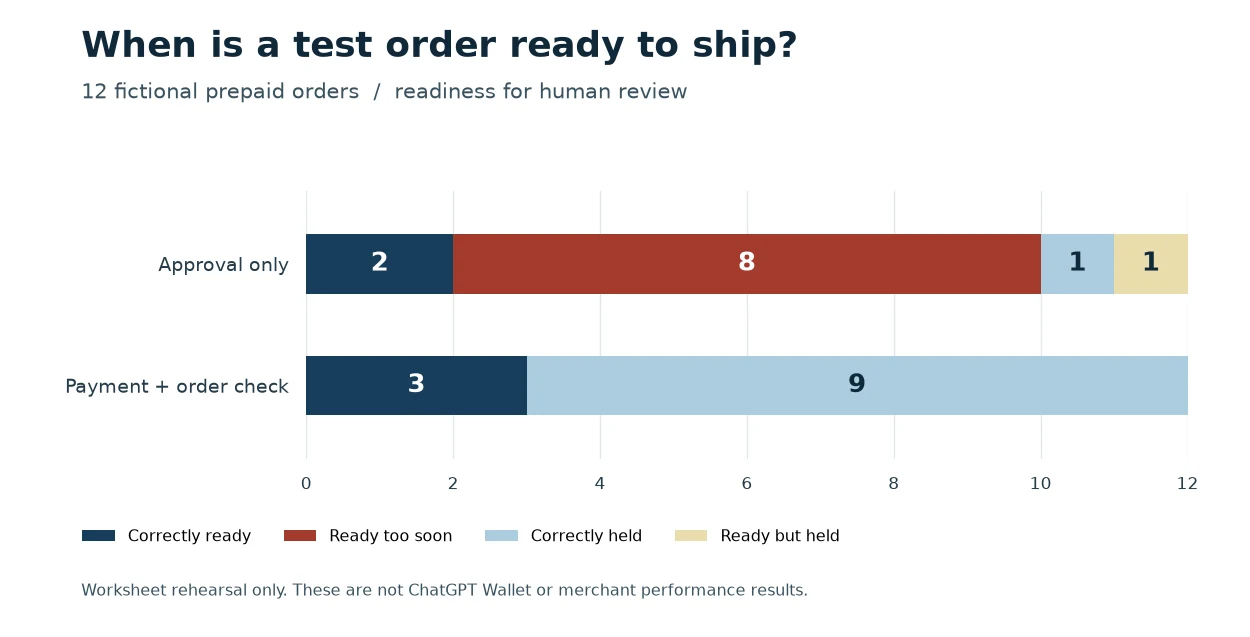
2026-11-16_agent-checkout-order-confirmation/evidence/results.json, outputs.jsonl and plot_metadata.json.This is useful evidence for the control design, not a product-performance claim. The cases are synthetic and intentionally cover pending, declined, missing, cancelled, mismatched-reference, mismatched-amount, mismatched-currency and unknown-approval states. There were no live Wallet calls, no merchant checkout, no model calls, no outbound network requests, no customer records and no transaction notifications. The rehearsal cannot tell you how often real shoppers will encounter a failed agent-assisted checkout. It can show whether your proposed worksheet catches the kinds of contradictions that should stop fulfilment.
What should an Australian SMB do next Monday?
You can rehearse this control without waiting for ChatGPT Wallet to reach Australia. The exercise is for your existing checkout and fulfilment process, with synthetic data first. Use a test-mode store or a locally held fixture file; do not create a live charge just to prove that a checklist exists.
Prerequisites
- A read-only view, test-mode export or safe fixture for your payment records and merchant orders.
- A blank worksheet with the three columns: buyer approval, payment result and merchant confirmation.
- One named reviewer from customer service and one person who understands the fulfilment queue.
- A stop rule agreed in advance: no release while payment or order status is pending, missing, declined, cancelled or mismatched.
- Fictional references, amounts and customer names; never card numbers, security codes, addresses or unredacted customer messages.
Seven executable steps
- Write the release condition. For a prepaid physical order, state that the order must be confirmed, the payment must be final under your provider’s documented status, and the reference, amount and currency must match. Add the person who can approve the final release.
- Create one fictional row. Enter “approved” for buyer approval, “pending” for payment and “no order” for merchant confirmation. Give the row a fake reference and a future review time. The expected decision is hold.
- Replay the original records. In test mode or in the saved fixture, look up the payment reference first, then the order reference. Record only the minimum internal identifiers needed to reproduce the lookup.
- Match the fields. Check status, reference, amount and currency. Do not turn a pending status into success because a customer is waiting or because a browser returned to the checkout page.
- Route the outcome. A complete match can enter a human-review queue. A missing or contradictory field goes to hold with an owner and a next-check time. “No order found” is a useful result; it is not permission to ask the customer to pay again.
- Test the exceptions. Add at least one declined payment, one missing order, one cancelled order, one mismatched reference, one amount mismatch, one currency mismatch and one case where merchant records match but buyer approval is unknown. Confirm that the worksheet sends each exception to the intended queue.
- Run a handover. Ask a second person to read the row without verbal help. They should be able to say what is known, what is missing, who owns the next check and when the customer will receive an update. If they cannot, improve the rule before connecting automation.
Verification criteria and stop condition
The rehearsal passes when every row has a recorded expected outcome, every decision can be traced to the four matching fields, sensitive data stays out of the shared worksheet, and the second reviewer can follow the handover. Stop the process immediately if any status is pending or ambiguous, if the payment and order refer to different transactions, if the amount or currency differs, if a risk system blocks the attempt, or if nobody with the right permission can verify the source record. Keep the item in the human queue; do not retry a charge or release stock to make the dashboard look tidy.
Rollback and human review
If you later automate the worksheet, start with read-only lookups and a draft decision. Before a pilot, save the previous manual queue, give the automation no direct fulfilment or payment-write permission, and define a visible disable switch. If a test produces an unexpected decision, disable the rule, return the affected item to manual review, preserve the input and output records, and tell the customer only what has been verified. Recovery is part of the design, not an apology after launch.
How should you adapt an existing Australian checkout?
OpenAI’s payment guide says ChatGPT Wallet can work with existing checkout pages and payment forms, and that no Wallet-specific integration is required. That is a reason to keep the first project small. Review your current payment statuses, order states and fulfilment handoff rather than adding a new side channel that nobody owns. The guide also warns that cloud-browser traffic can trigger risk systems and cause purchases to fail. A failed agent-assisted attempt should therefore create a reviewable exception, not an automatic second attempt.
For an Australian team, make your worksheet match the information people already use: Australian Eastern time for the next check, the store’s actual currency and tax display, the gateway’s documented status names, the order reference used by the warehouse, and the shipping cut-off that your team has already approved. Those are operational fields, not promises about OpenAI’s rollout or a particular payment provider. If your store sells subscriptions, takes deposits or captures later, write a separate rule rather than quietly applying the prepaid-order rule to every transaction.
The customer-facing message should also be part of the control. A short template can say that the business is verifying the payment and order records, that no duplicate payment is required while the check is open, and when the next update will arrive. Avoid claiming that an order exists until your merchant system confirms it. Avoid claiming that a payment failed when the gateway status is still pending.
What should change, and what should stay the same?
Change the handoff, not the whole store. Add the three-column record, define the release condition, assign an owner and retain the source references needed for a human to verify the result. Give customer service a precise response for “I approved it but cannot see my order”. Give fulfilment a clear hold state. Give whoever manages automation a test set that includes contradictions instead of only happy-path orders.
Keep your existing merchant relationship, checkout ownership and secure payment-data practice. OpenAI’s guidance says the business continues to handle orders, fulfilment, customer support and fraud decisions; it does not transfer those responsibilities to a chat assistant. If you want to connect this control to a broader workflow, RxAI’s AI consulting for e-commerce teams is the relevant service context. The first deliverable should still be a reviewable rule and a rehearsal record, not a promise of autonomous shipping.
This is the same operating discipline behind our earlier guide to setting payment boundaries before automation and our article on human approval before high-risk actions. If the exception starts as a vague customer message, our support handoff guide shows how to preserve enough context for somebody else to reproduce the problem. The common thread is simple: define the decision, keep the evidence, and leave a named person at the irreversible edge.
What will prove the control is ready to automate?
Do not use a single successful test as proof. Expand the fixture set until it reflects the exceptions your store actually sees: pending authorisations, duplicate notifications, cancellations, refunds, partial captures, currency differences, missing webhooks and customer messages that do not expose the approval state. For each case, write the expected queue and the reason. Then run the set whenever you change the checkout, gateway mapping or fulfilment integration.
A useful readiness record contains the test date in Australia/Sydney, the rule version, the number of cases, the count of correct and premature decisions, any unresolved cases, the reviewer and the rollback action. That creates a small evidence trail a business owner can understand. It also prevents a future automation project from confusing a product announcement with a validated operating capability.
When the evidence is consistent, automate the reversible work first: retrieve records, compare fields, draft the customer update and place a verified match in a human-review queue. Keep payment retries, stock release, refunds and other consequential actions behind an explicit approval until your team has evidence that those steps are safe for your particular systems. The result is less dramatic than “let the agent run the shop”, but it is far more useful on Monday morning.
Primary sources and method
The product facts were checked against five first-party OpenAI sources on 17 November 2026 Australia/Sydney: Introducing ChatGPT Wallet; Making purchases with ChatGPT Wallet; Accept payments; the Commerce Partner Playbook; and the ChatGPT release notes. The article uses those sources for product availability, approval flow, payment-token handling, merchant responsibility, checkout compatibility and the distinction between approval and order confirmation.
The first-hand evidence is a local synthetic rehearsal, not customer or product evidence. Its exact command is saved in 2026-11-16_agent-checkout-order-confirmation/evidence/commands.txt; the fictional inputs are in evidence/inputs.json; the raw decisions are in evidence/outputs.jsonl; the measured summary is in evidence/results.json; and the chart metadata is in evidence/plot_metadata.json. The source package records the method, counts, timestamp and limitations.
RxAI’s judgement: Australian SMBs should treat agent-assisted checkout as a reason to strengthen order reconciliation now, not as a reason to wait for a new tool or to give an agent direct fulfilment authority. Approval, payment and merchant confirmation are separate facts. Make them meet in a small, reviewable control before anything irreversible happens.
Frequently Asked Questions
No. Buyer approval is one signal. Check the merchant’s confirmed order and reconcile it with the payment result, reference, amount and currency before fulfilment.
OpenAI’s current material describes a gradual rollout to eligible US ChatGPT Pro users through dots, with US-issued cards and a US billing address. Do not assume Australian availability; rehearse the control against your existing checkout instead.
Record buyer approval as a separate signal, then verify the payment status and reference, and confirm the merchant order with matching reference, amount and currency. Keep a named reviewer and a next-check time.
Stop and route to human review for a pending, declined, cancelled, missing or mismatched record, an unexpected risk block, or any case where the authorised operator cannot verify the original source.
Want This Applied to Your Business?
RxAI offers a free 20-minute consultation to map how these strategies fit your operations. No obligation, no sales pitch.
Book Free Consultation